Activity

Please draw your own subjective distributions for the following events/items.

  1. The probability that it will snow at Reed this winter.
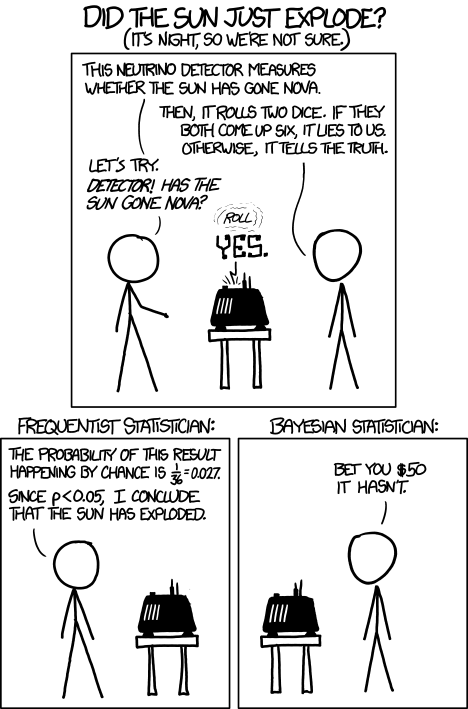
  2. The probability that, on a given night, the sun has gone supernova.
  3. The total number of individual socks that you own.


Bayesian Estimation1


Grayson White

Math 141
Week 14 | Fall 2025

Goals for today

  • Discuss socks

No… not that socks

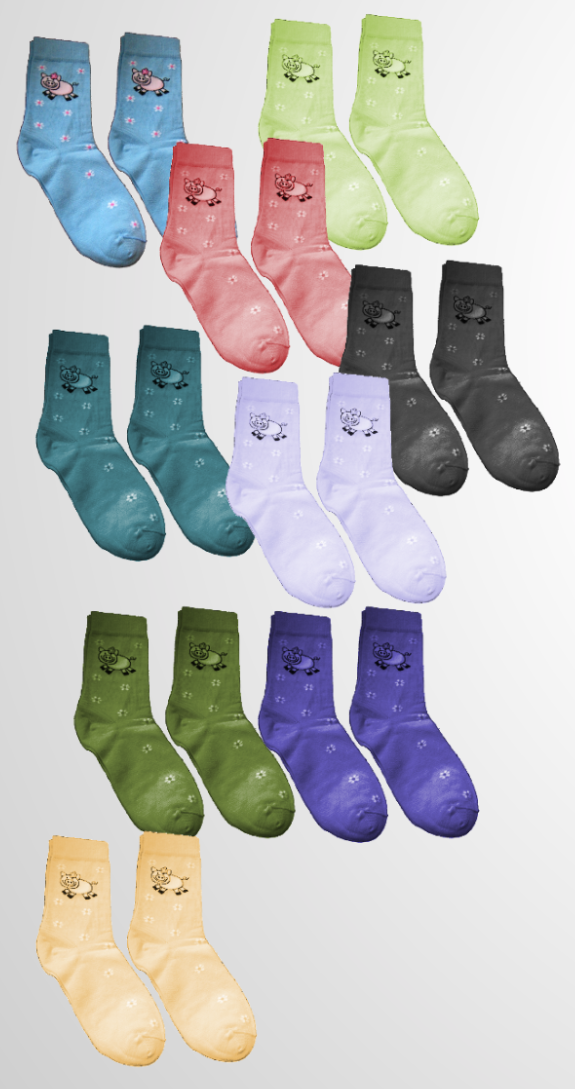
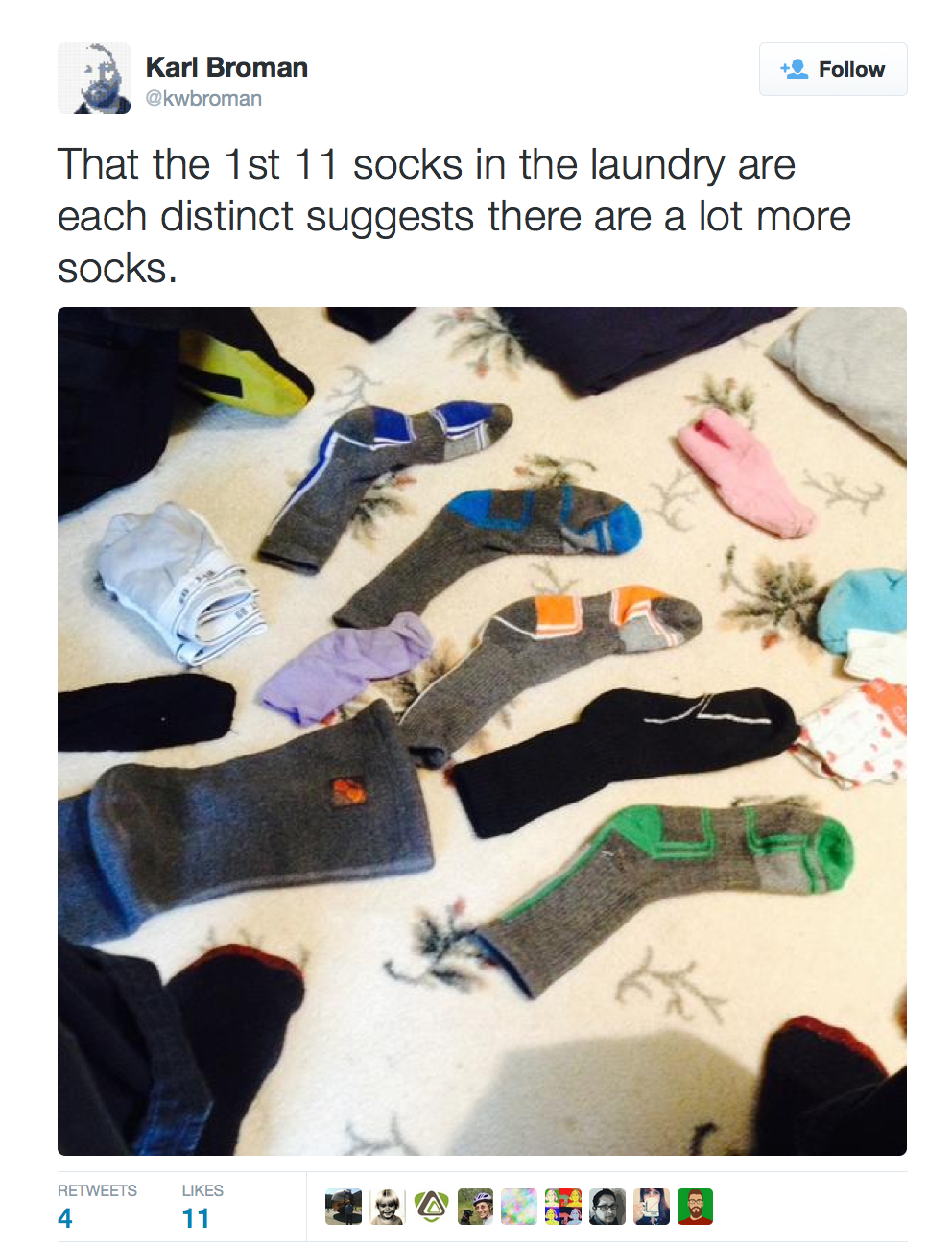
Karl Broman’s socks

Karl Broman’s socks

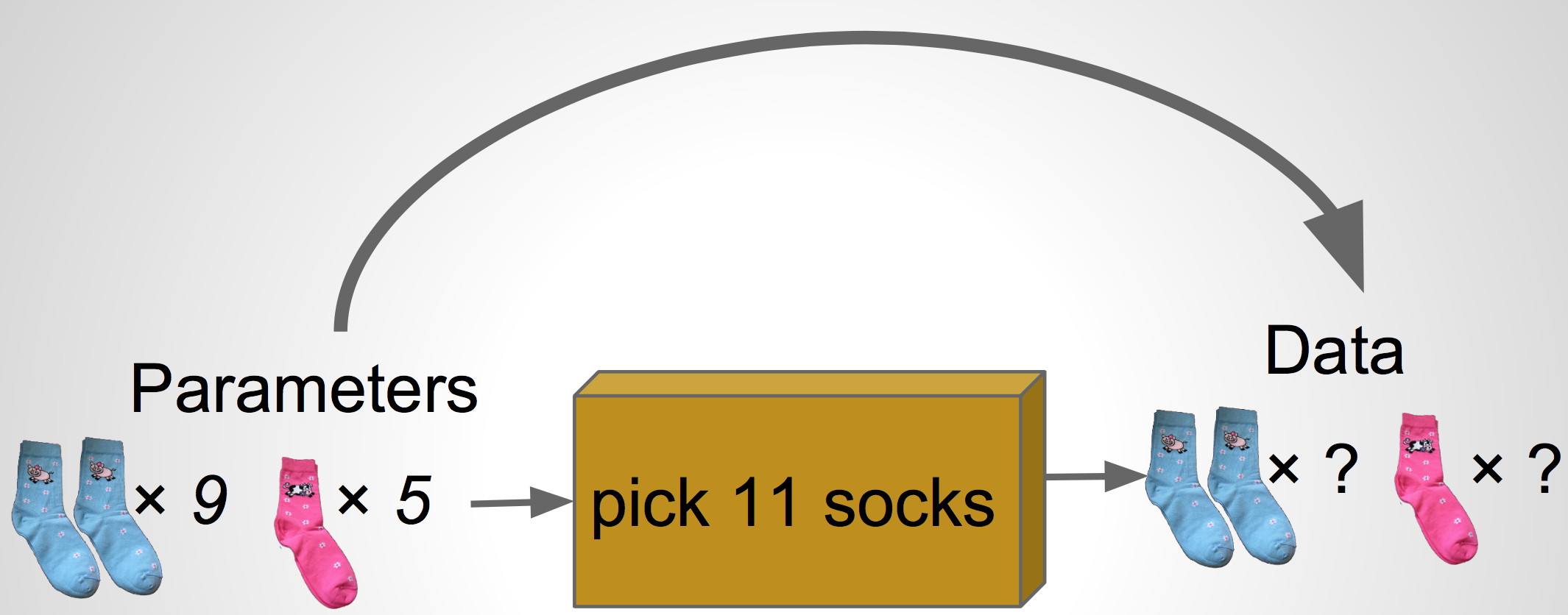
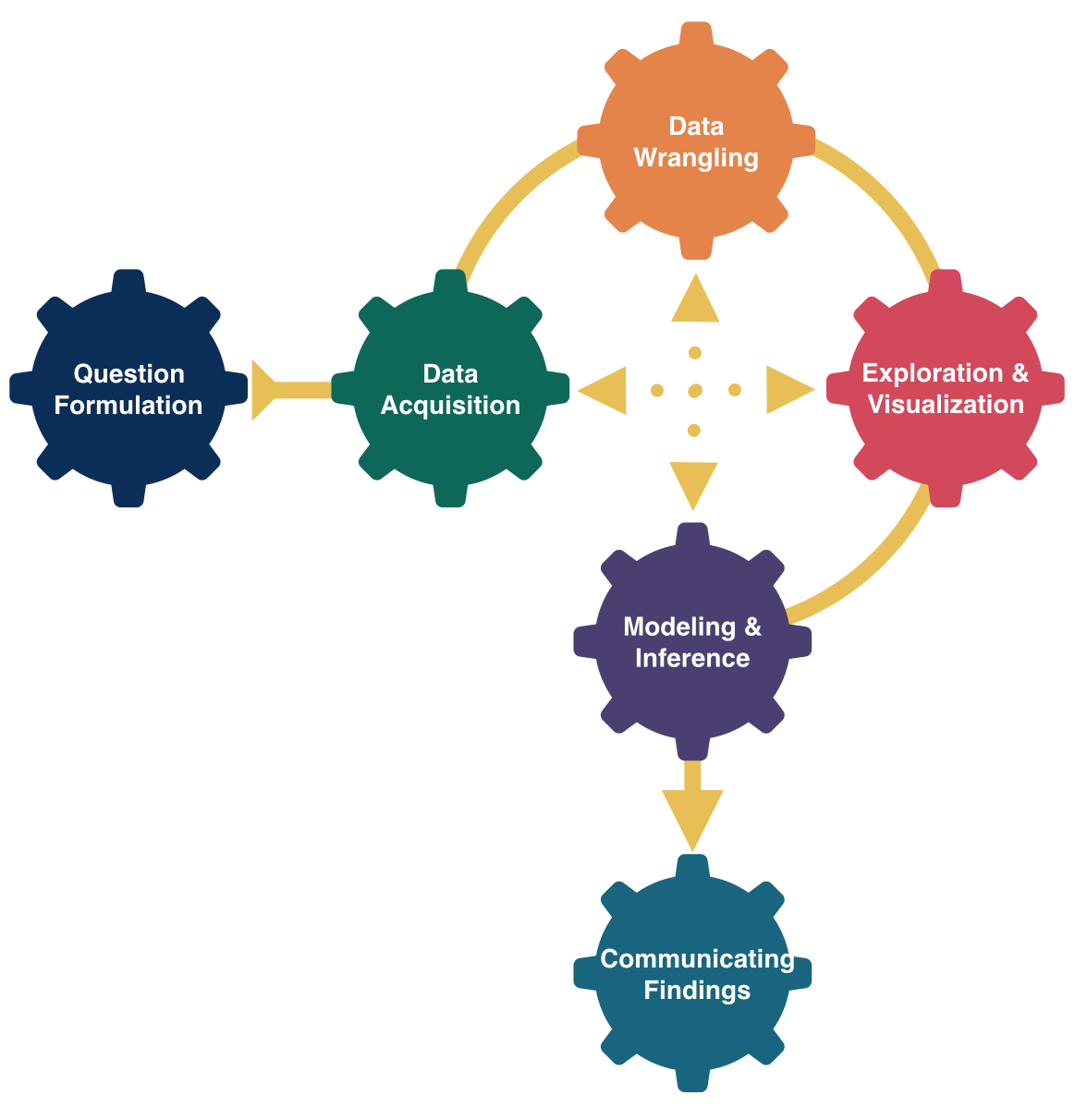
Let’s formalize this…

Classical hypothesis test (what we learned this semester!)

Assert a model (i.e., state the null hypothesis)

  • \(H_o\): I have \(N_{pairs}\) pairs of socks and \(N_{singles}\) singletons. The first 11 socks that I pull out of the machine are a random sample from this population.

Decide on a test statistic

  • The number of singletons in the sample: 11.

Construct the null distribution

  • Probability theory or simulation.

See where your observed stat lies in that distribution

  • Find the p-value.

The null hypothesis

\[N_{pairs} = 9\]

The null hypothesis
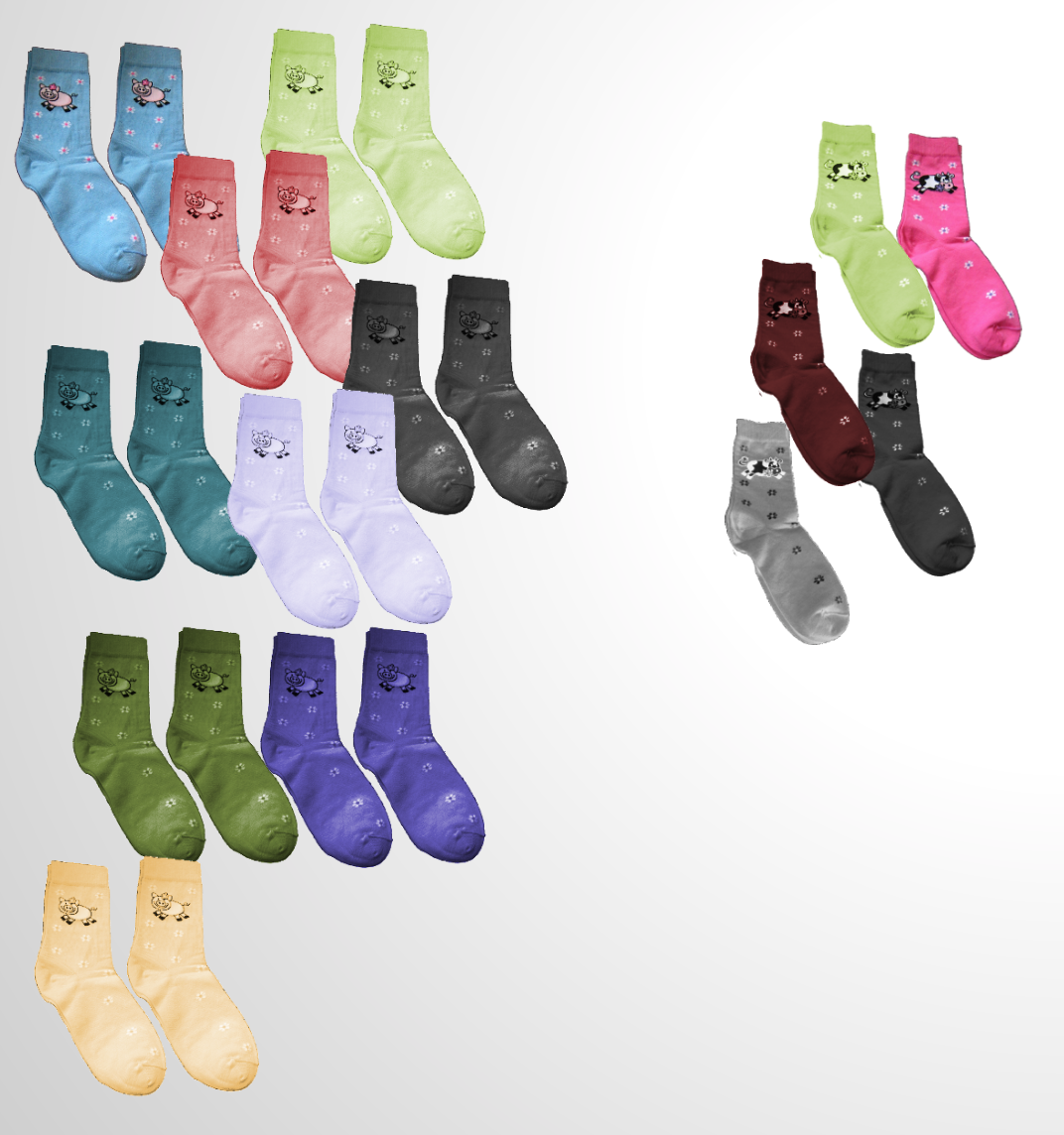
\[N_{pairs} = 9; \quad N_{singles} = 5\]

Constructing the null distribution

We’ll use simulation.

Create the population of socks:

sock_pairs <- c("A", "B", "C", "D", "E", 
                "F", "G", "H", "I", "J", "K")
sock_singles <- c("l", "m", "n", "o", "p")
socks <- c(rep(sock_pairs, 
               each = 2), 
           sock_singles)
socks
 [1] "A" "A" "B" "B" "C" "C" "D" "D" "E" "E" "F" "F" "G" "G" "H" "H" "I" "I" "J"
[20] "J" "K" "K" "l" "m" "n" "o" "p"

One draw from the machine

picked_socks <- sample(socks, size = 11, replace = FALSE)
picked_socks
 [1] "H" "J" "B" "F" "H" "n" "m" "C" "A" "D" "A"
sock_counts <- data.frame(picked_socks) %>%
  count(picked_socks)
sock_counts
  picked_socks n
1            A 2
2            B 1
3            C 1
4            D 1
5            F 1
6            H 2
7            J 1
8            m 1
9            n 1
n_singles <- sock_counts %>%
  summarize(n = sum(n == 1)) %>%
  pull()
n_singles
[1] 7

Our simulator

Constructing the null distribution

pick_socks(N_pairs = 9, N_singles = 5,
           N_pick = 11)
[1] 11
pick_socks(9, 5, 11)
[1] 7
pick_socks(9, 5, 11)
[1] 7

Repeat many, many times…

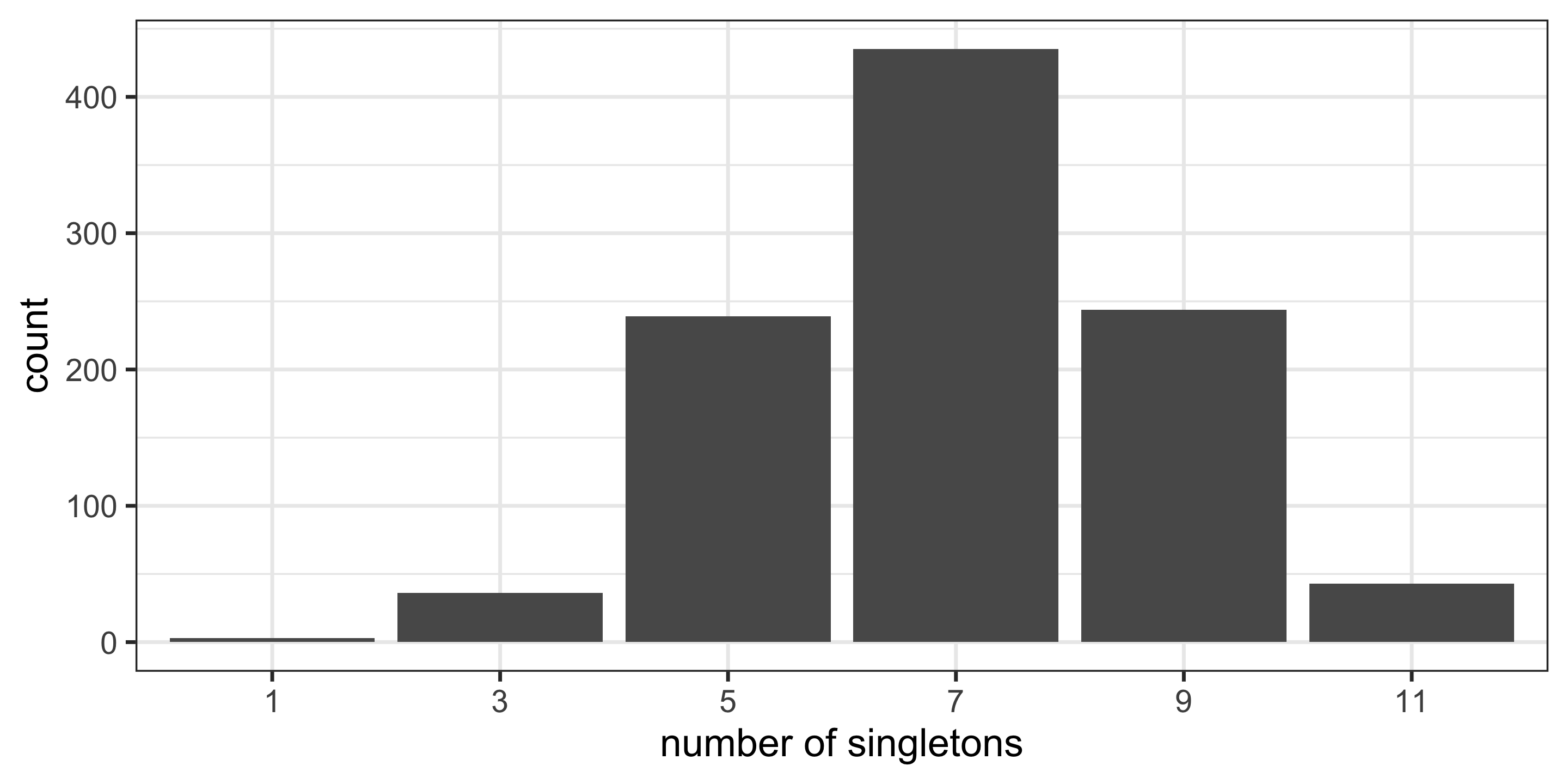
The null distribution

set.seed(301)
sim_singles <- rep(0, 1000)

for (i in 1:1000) {
  sim_singles[i] <- pick_socks(9, 5, 11)
}

ggplot(data.frame(sim_singles),
       aes(x = as.factor(sim_singles))) +
  geom_bar() +
  labs(x = "number of singletons") +
  theme_bw(base_size = 18)

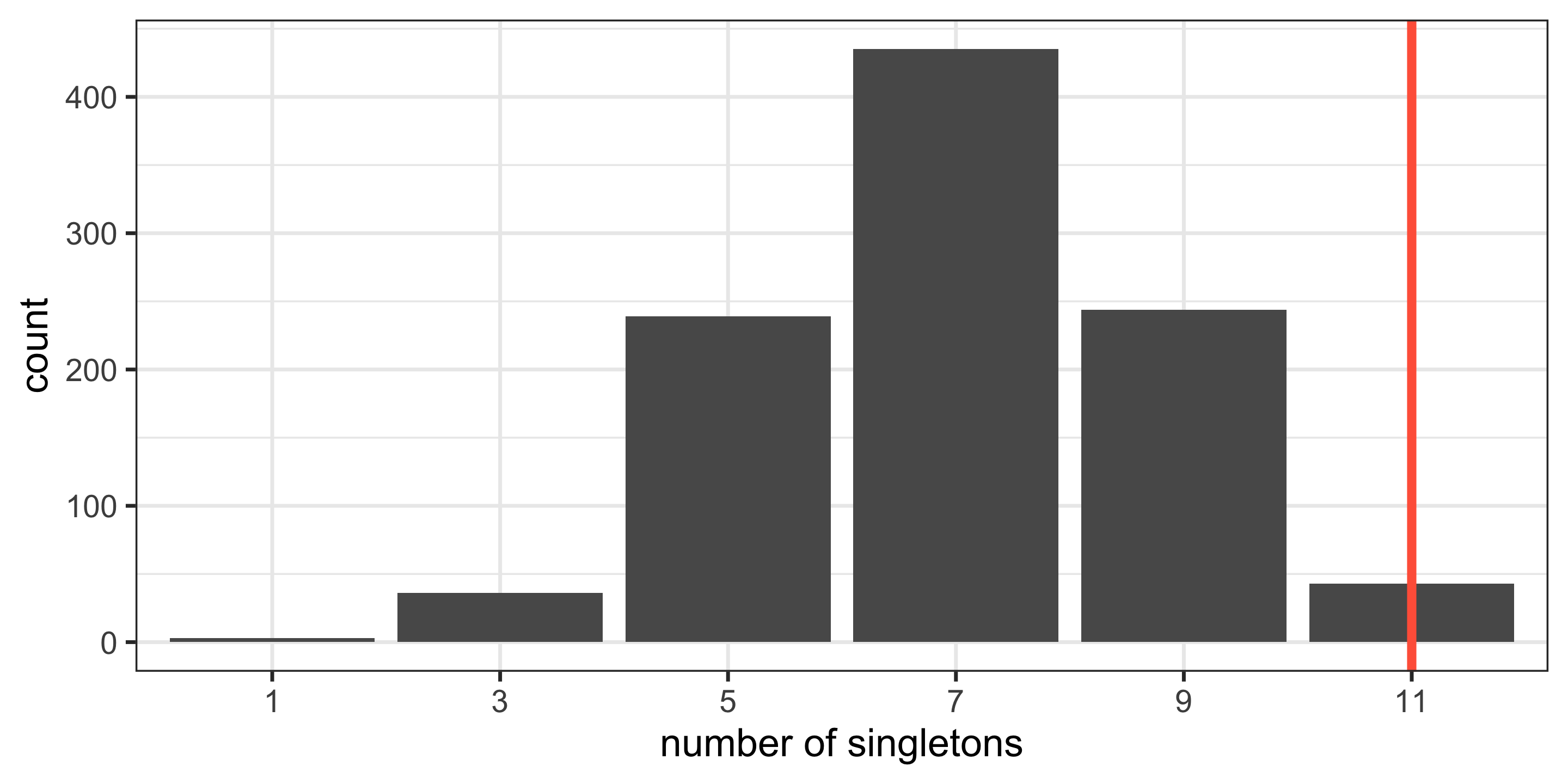
The null distribution

ggplot(data.frame(sim_singles),
       aes(x = as.factor(sim_singles))) +
  geom_bar() +
  labs(x = "number of singletons") +
  theme_bw(base_size = 18) +
  geom_vline(xintercept = 6, col = "tomato", size = 2)

The p-value

Quantifying how far into the tails our observed count was.

head(sim_singles)
[1] 9 9 5 7 7 7
pval <- data.frame(sim_singles) %>%
  mutate(geq_11 = sim_singles >= 11) %>%
  summarize(pval = mean(geq_11)) %>%
  pull()

pval
[1] 0.043

Question

What is the best definition for our one-tailed p-value in probability notation?

  1. P(\(H_o\) is true | data) = 0.043
  2. P(\(H_o\) is false | data) = 0.043
  3. P(\(H_o\) is true) = 0.043
  4. P(data | \(H_o\) is true) = 0.043
  5. P(data) = 0.043

Question

What is the best definition for our one-tailed p-value in probability notation?

  1. P(\(H_o\) is true | data) = 0.043
  2. P(\(H_o\) is false | data) = 0.043
  3. P(\(H_o\) is true) = 0.043
  4. P(data | \(H_o\) is true) = 0.043
  5. P(data) = 0.043

The challenge with the classical method

The result of a hypothesis test is a probability of the form:

\[ P(\textrm{data or more extreme } | \ H_o \textrm{ true}) \]

but most people think they’re getting

\[ P(H_o \textrm{ true } | \textrm{ data}) \]

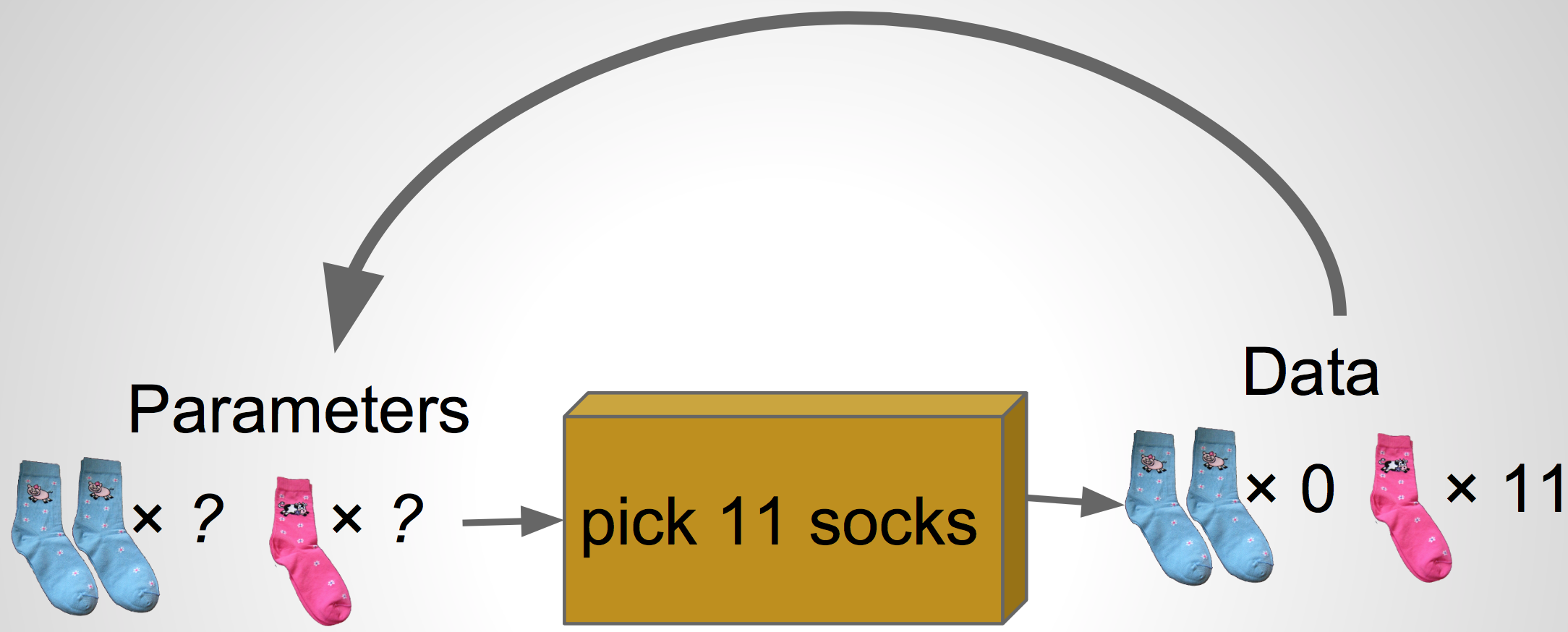
How can we go from the former to the latter?

What we have

What we want

Bayesian modeling via Bayes’ rule

\[P(A \ | \ B) = \frac{P(A \textrm{ and } B)}{P(B)} \]

\[P(A \ | \ B) = \frac{P(B \ | \ A) \ P(A)}{P(B)} \]

\[P(model \ | \ data) = \frac{P(data \ | \ model) \ P(model)}{P(data)} \]

What does it mean to think about \(P(model)\)?

Activity

Please draw your own subjective distributions for the following events/items.

  1. The probability that it will snow at Reed this winter.
  2. The probability that, on a given night, the sun has gone supernova.
  3. The total number of individual socks that you own.

Prior distribution

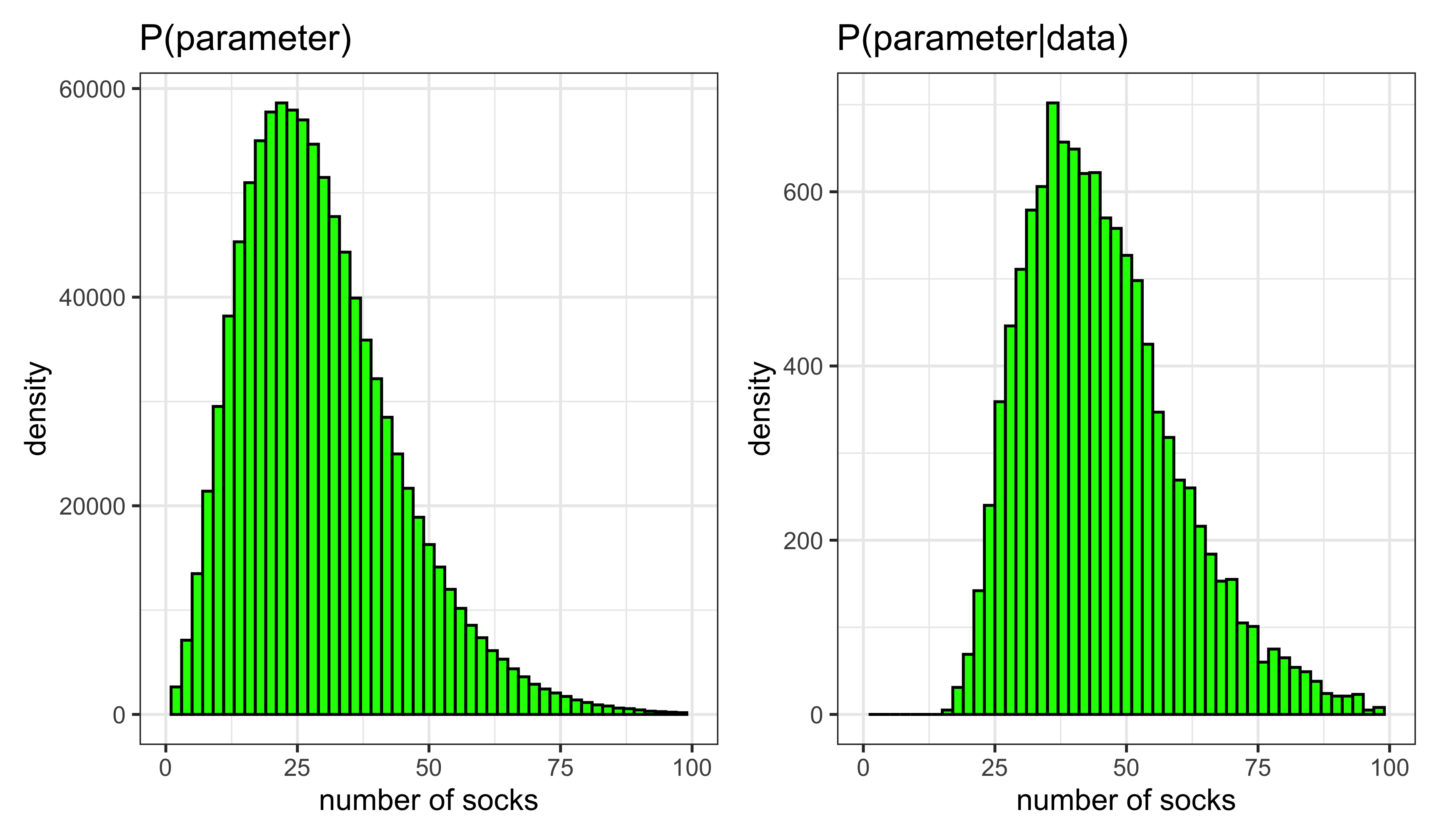
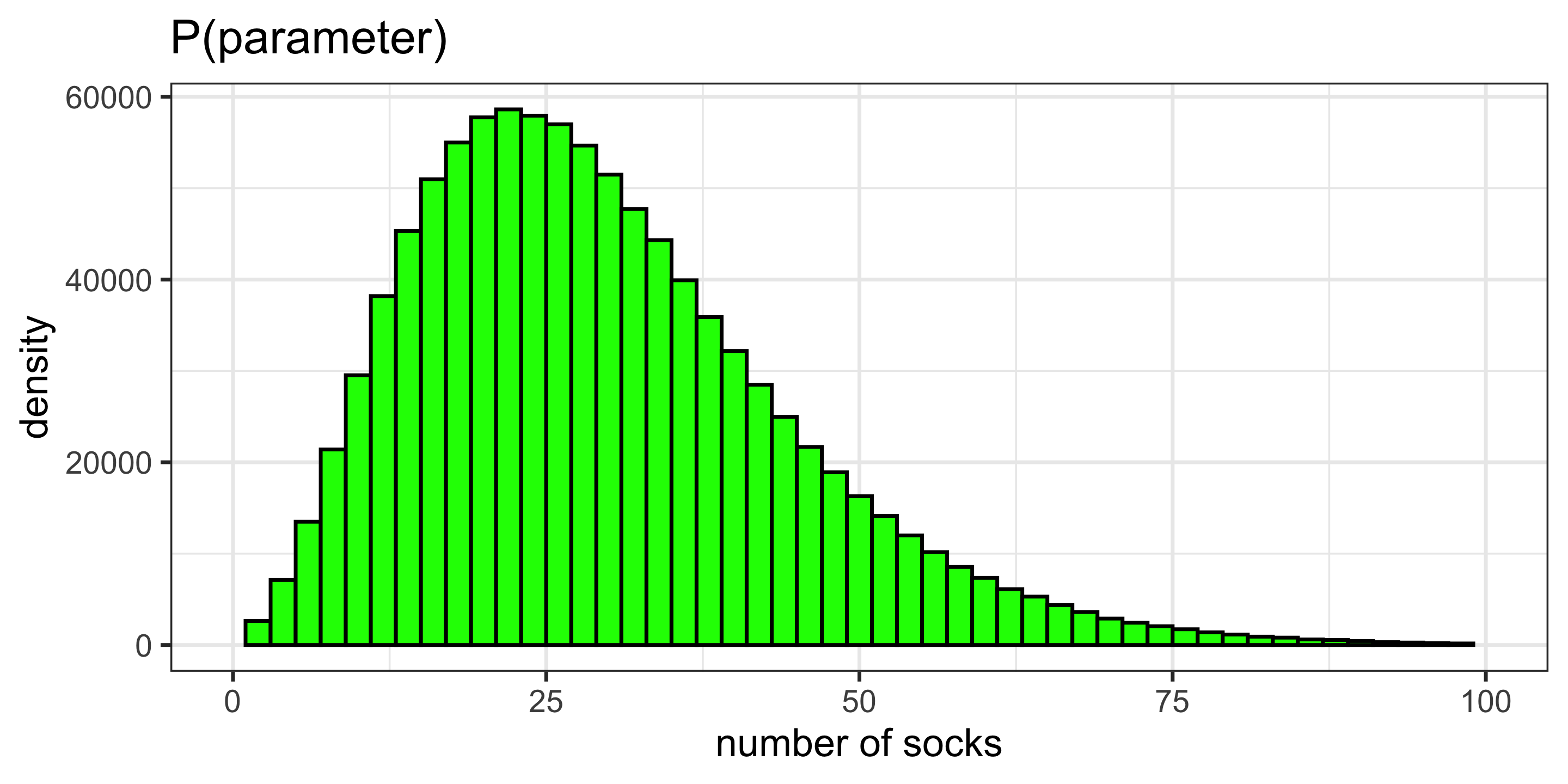
A prior distribution is a probability distribution for a parameter that summarizes the information that you have before seeing the data. Prior on \(N\):
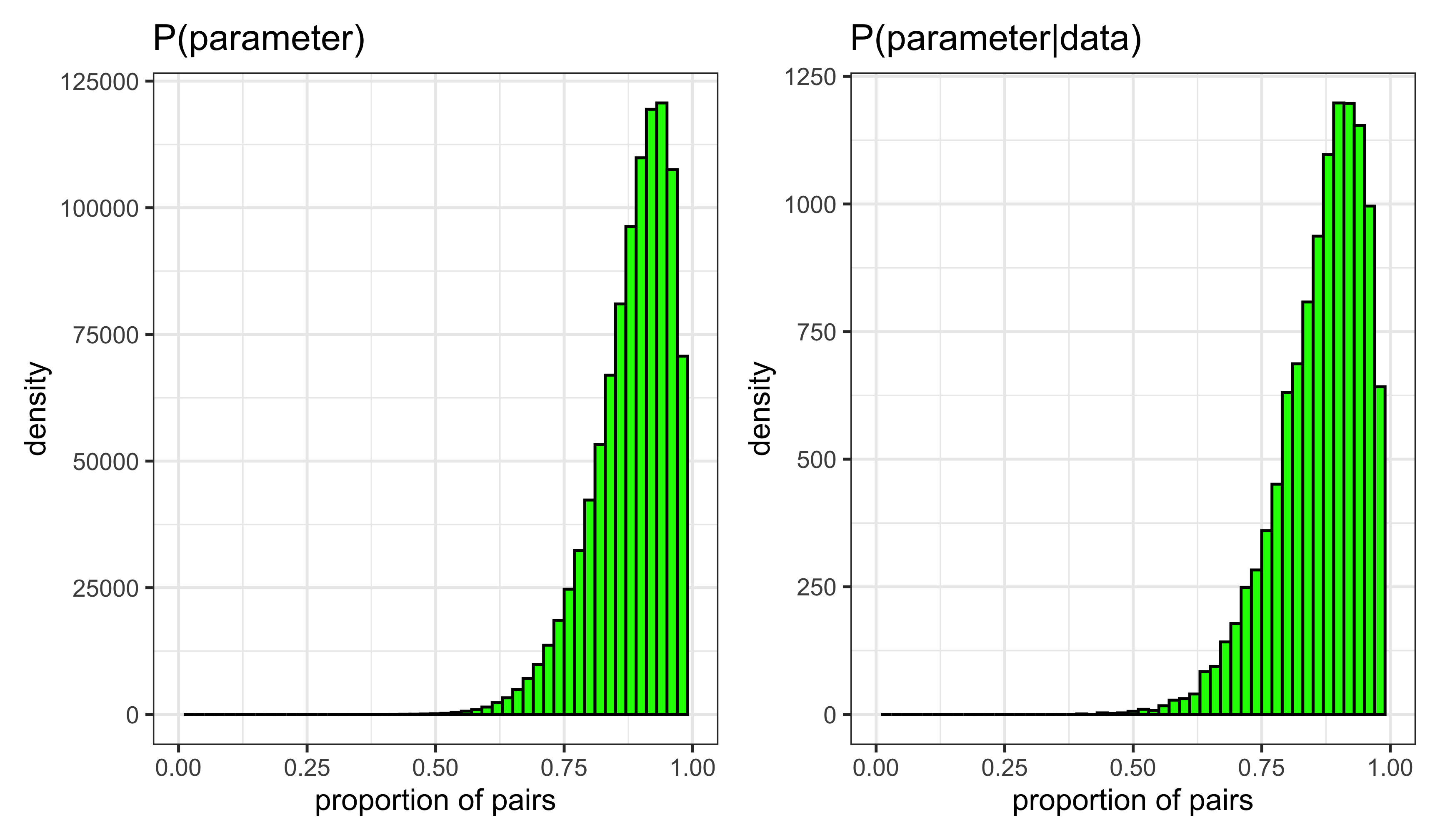
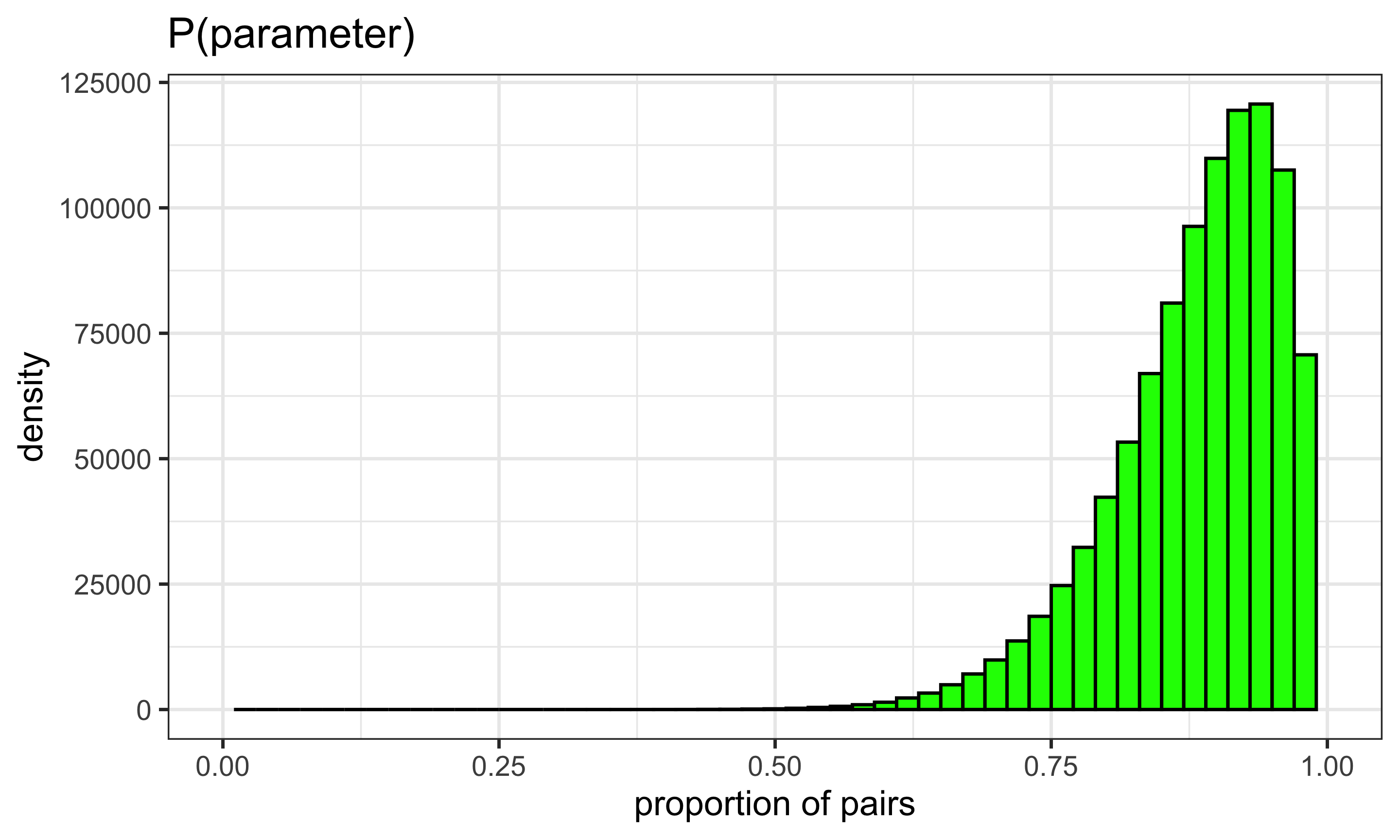
Prior on proportion pairs
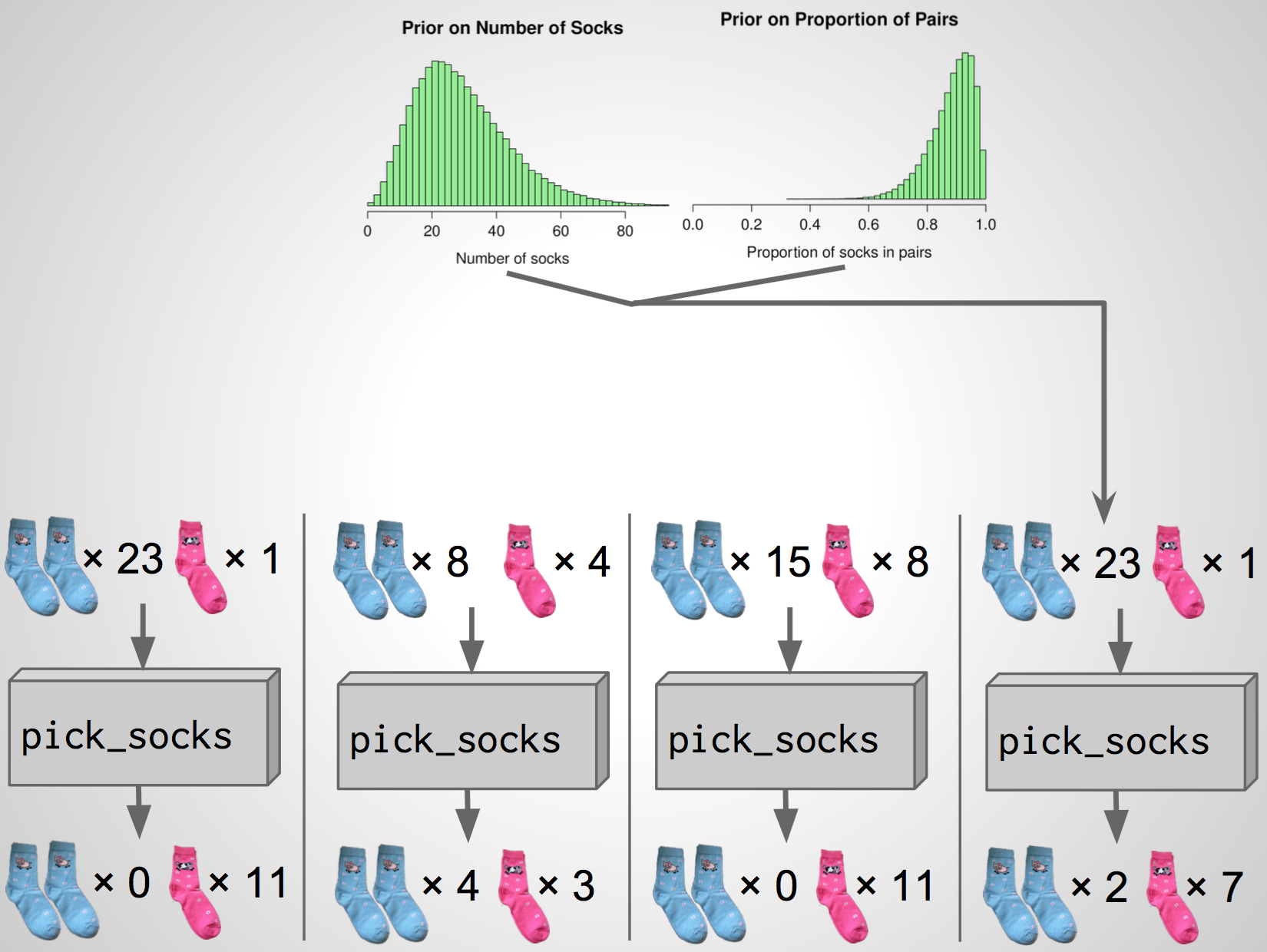
Our scheme
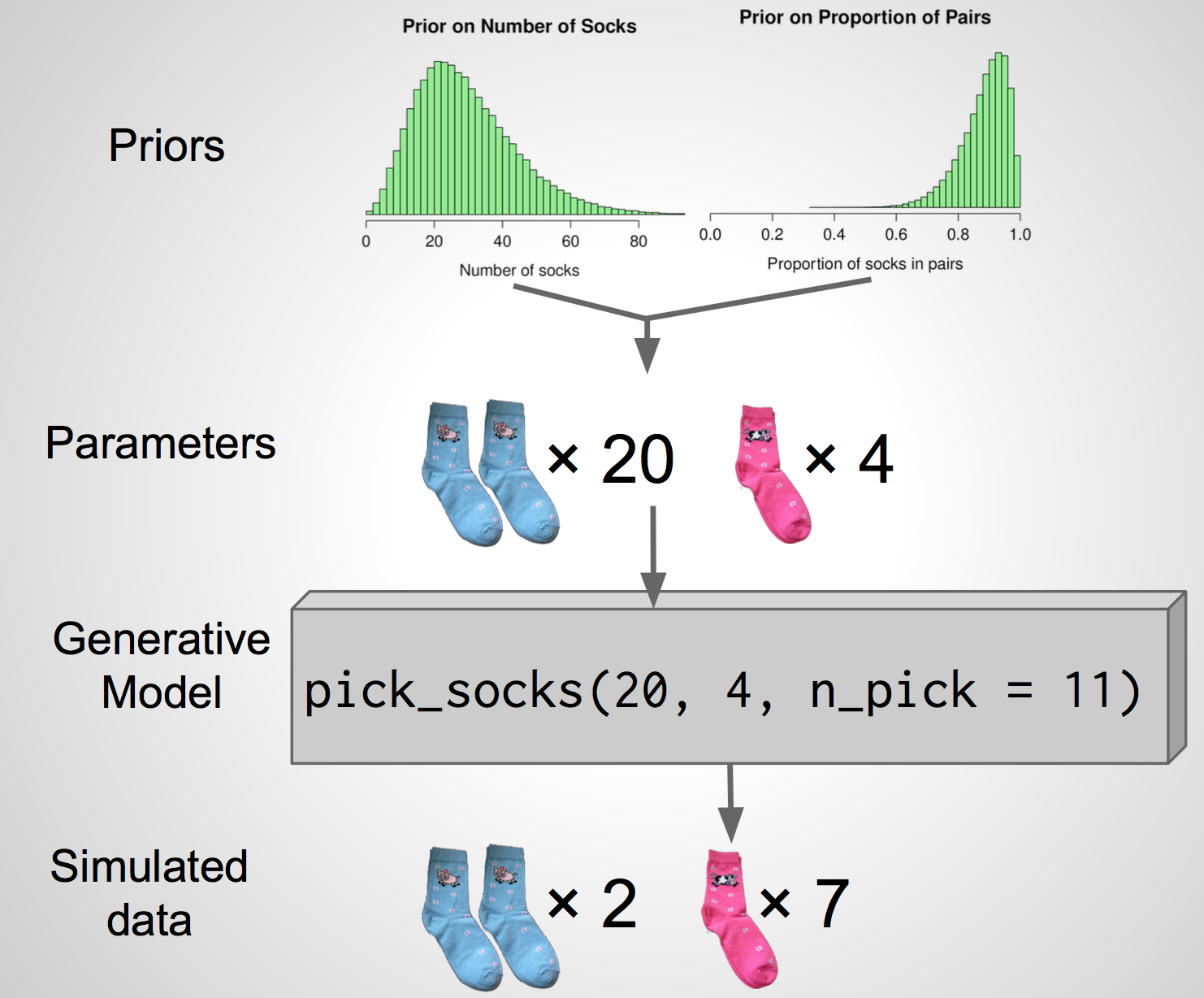
One simulation
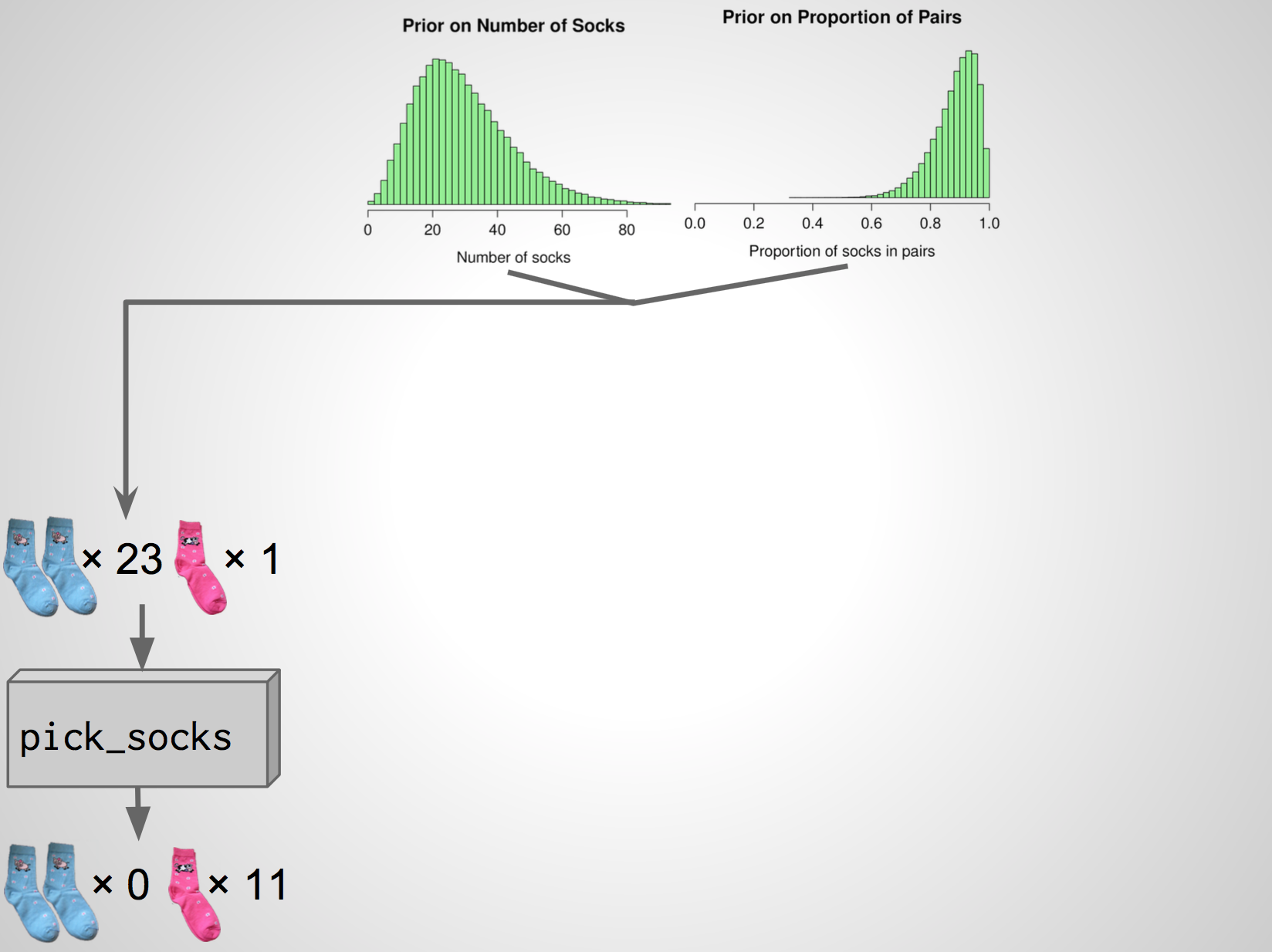
A second simulation
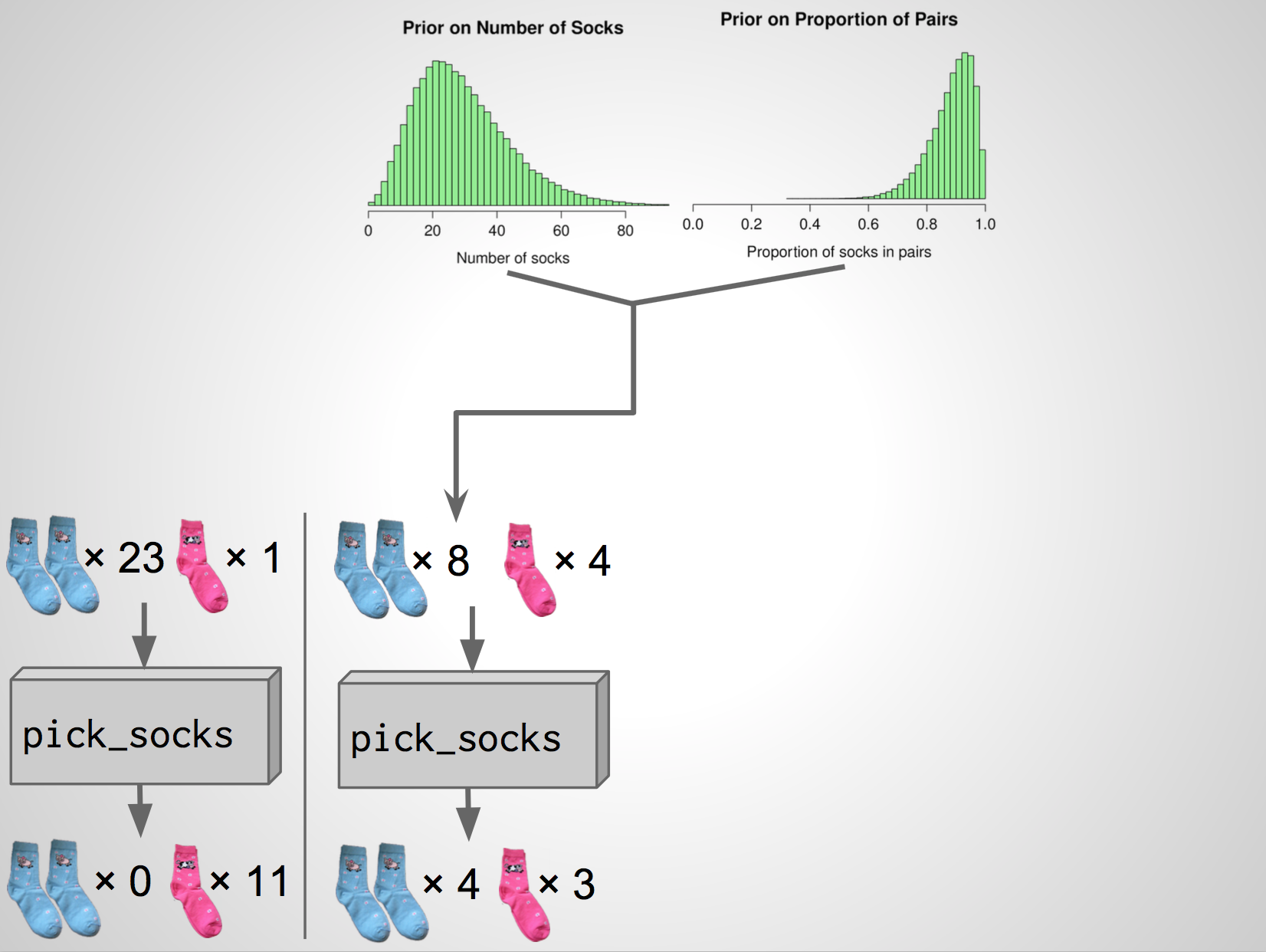
A third simulation
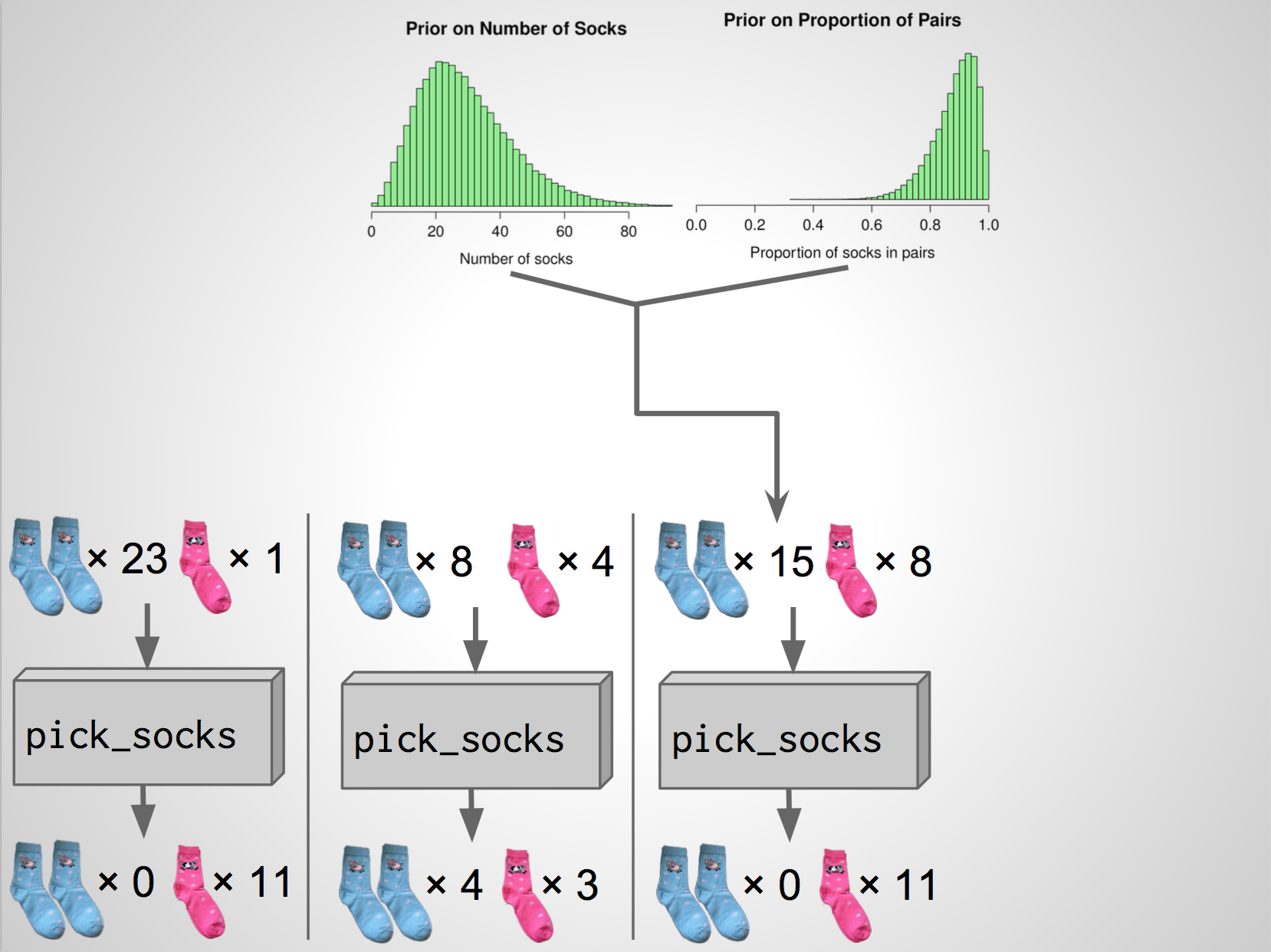
A fourth simulation
The actual data
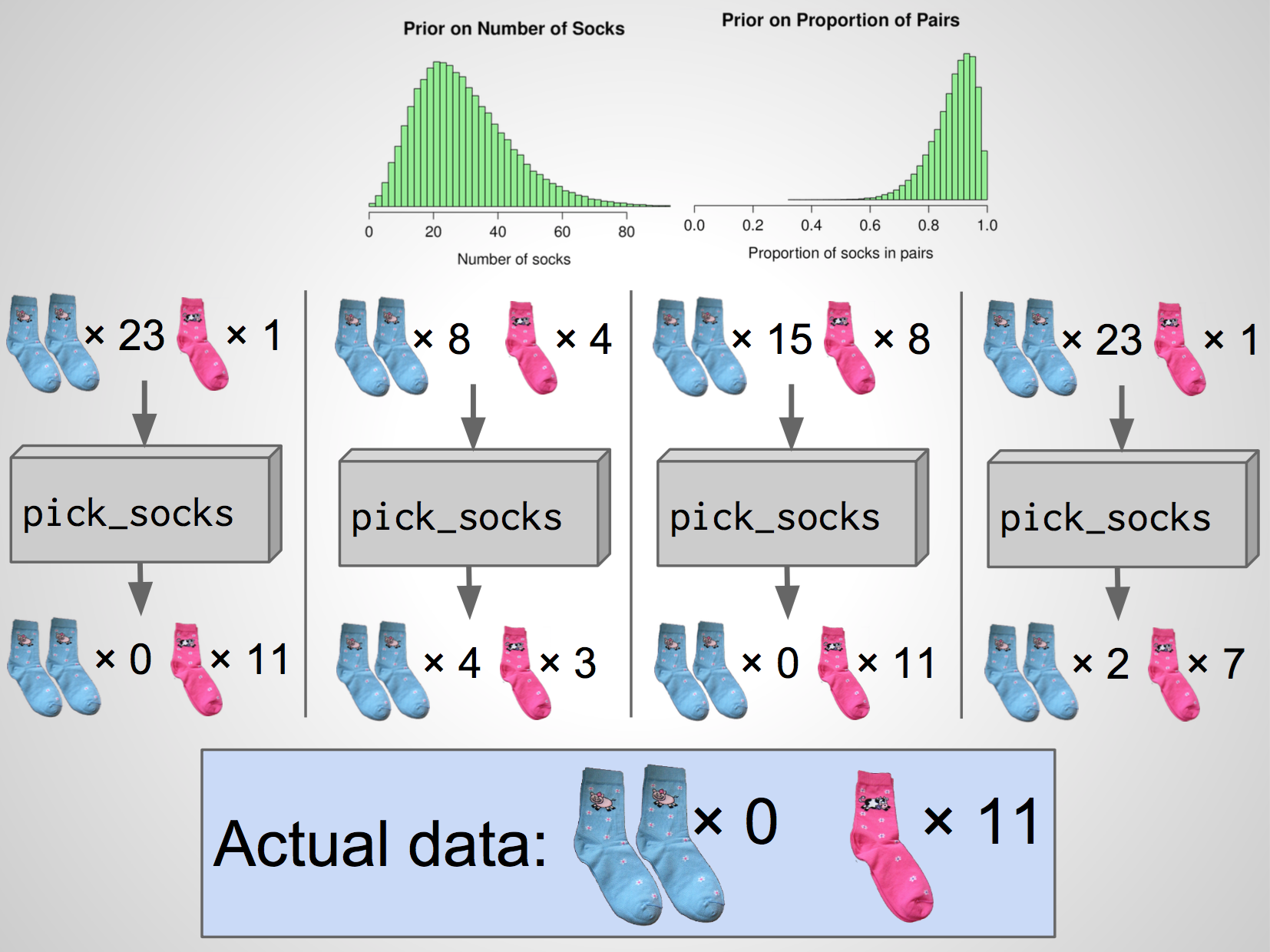
The actual data
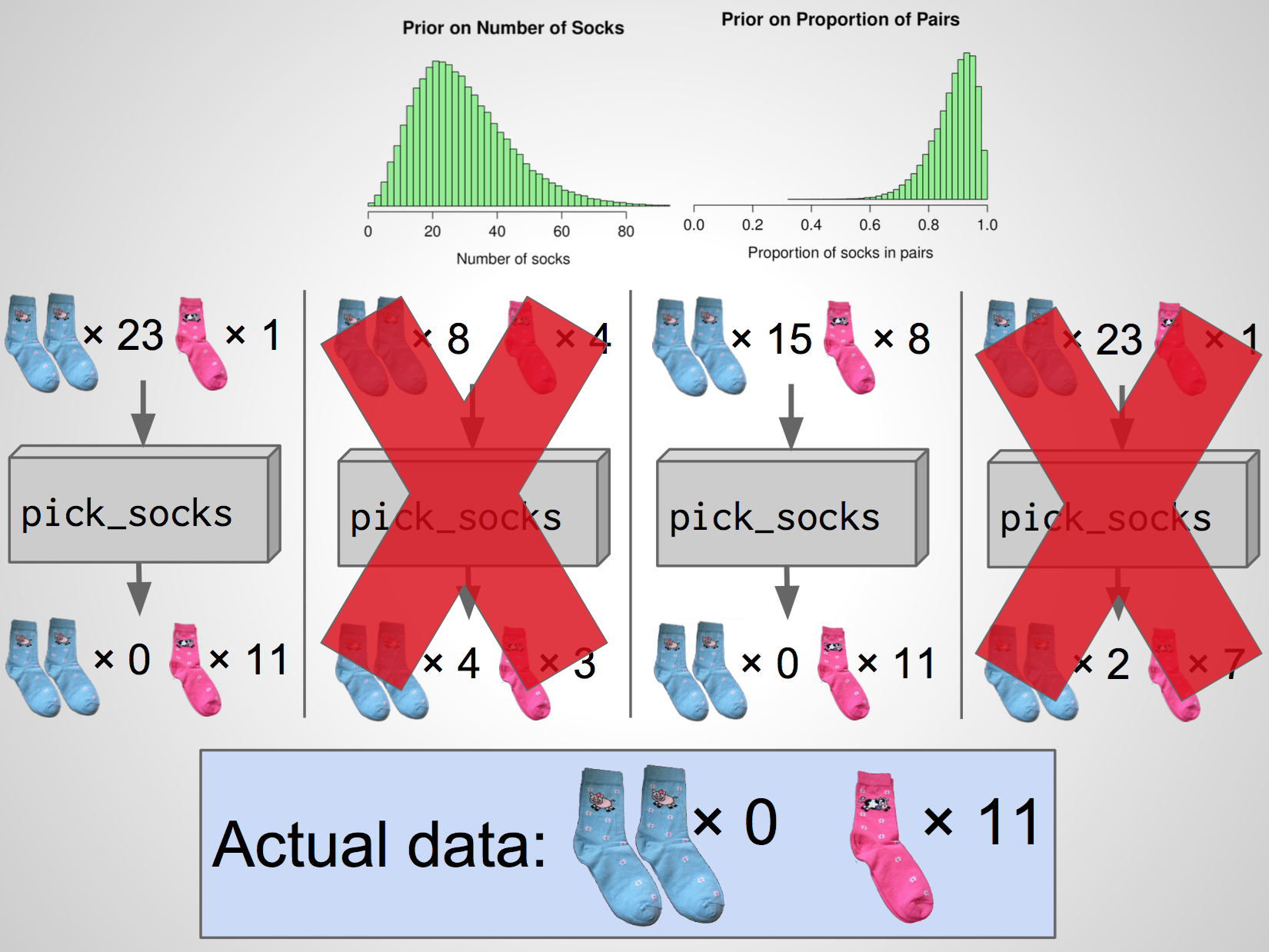
Full simulation1

head(sock_sim)
  singletons pairs n_socks prop_pairs
1          5     3      18      0.826
2         11     0      53      0.715
3          9     1      27      0.973
4          7     2      35      0.724
5          9     1      31      0.869
6          9     1      33      0.758
sock_sim %>%
  filter(singletons == 11, pairs == 0) %>%
  head()
  singletons pairs n_socks prop_pairs
1         11     0      53      0.715
2         11     0      41      0.885
3         11     0      53      0.957
4         11     0      37      0.773
5         11     0      45      0.880
6         11     0      51      0.754

Proportion of pairs

Number of socks

Karl Broman’s socks

The posterior distribution
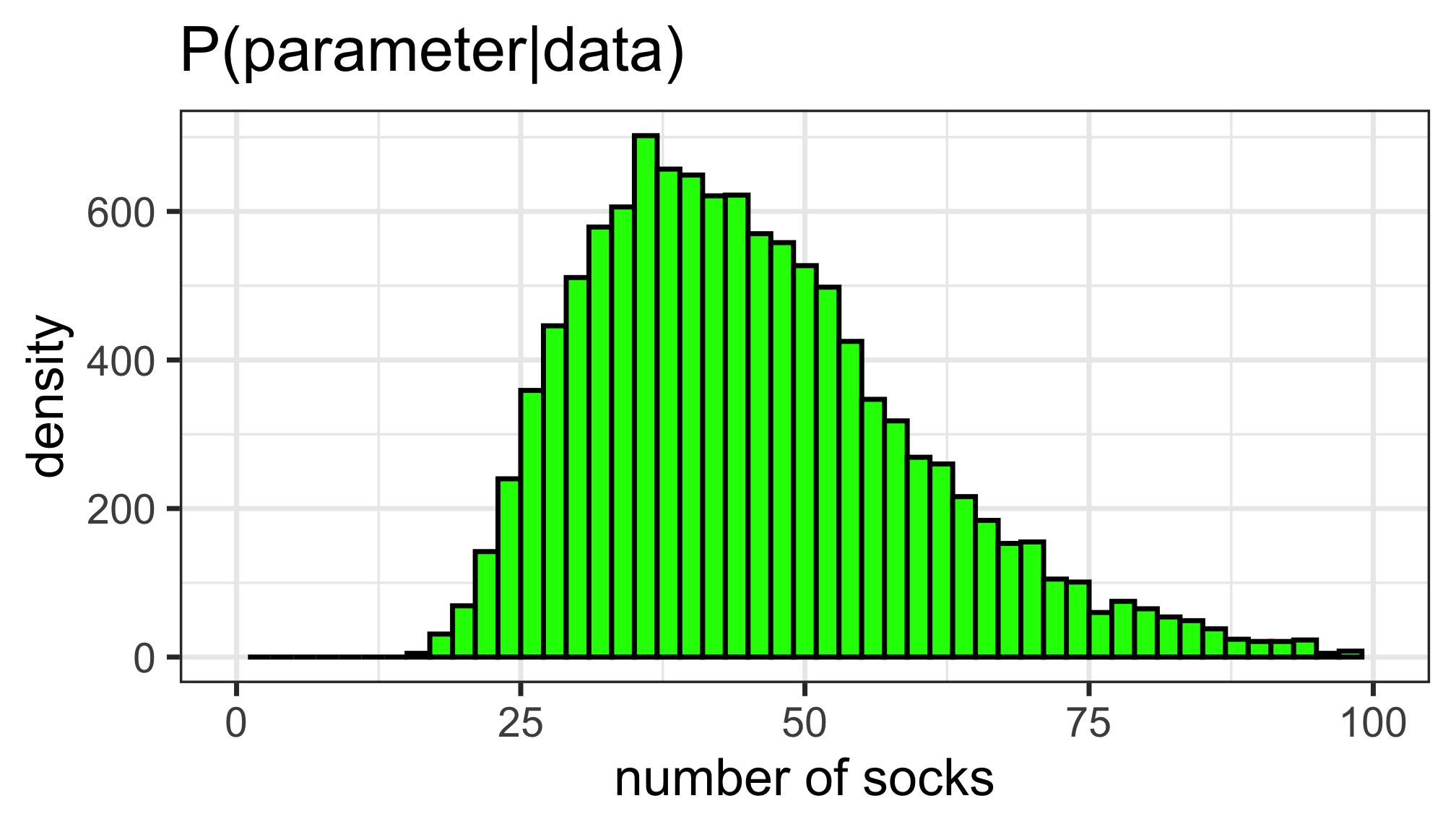
  • Distribution of a parameter after conditioning on the data
  • Synthesis of prior knowledge and observations (data)

Question

What is your best guess for the number of socks that Karl has?

Our best guess
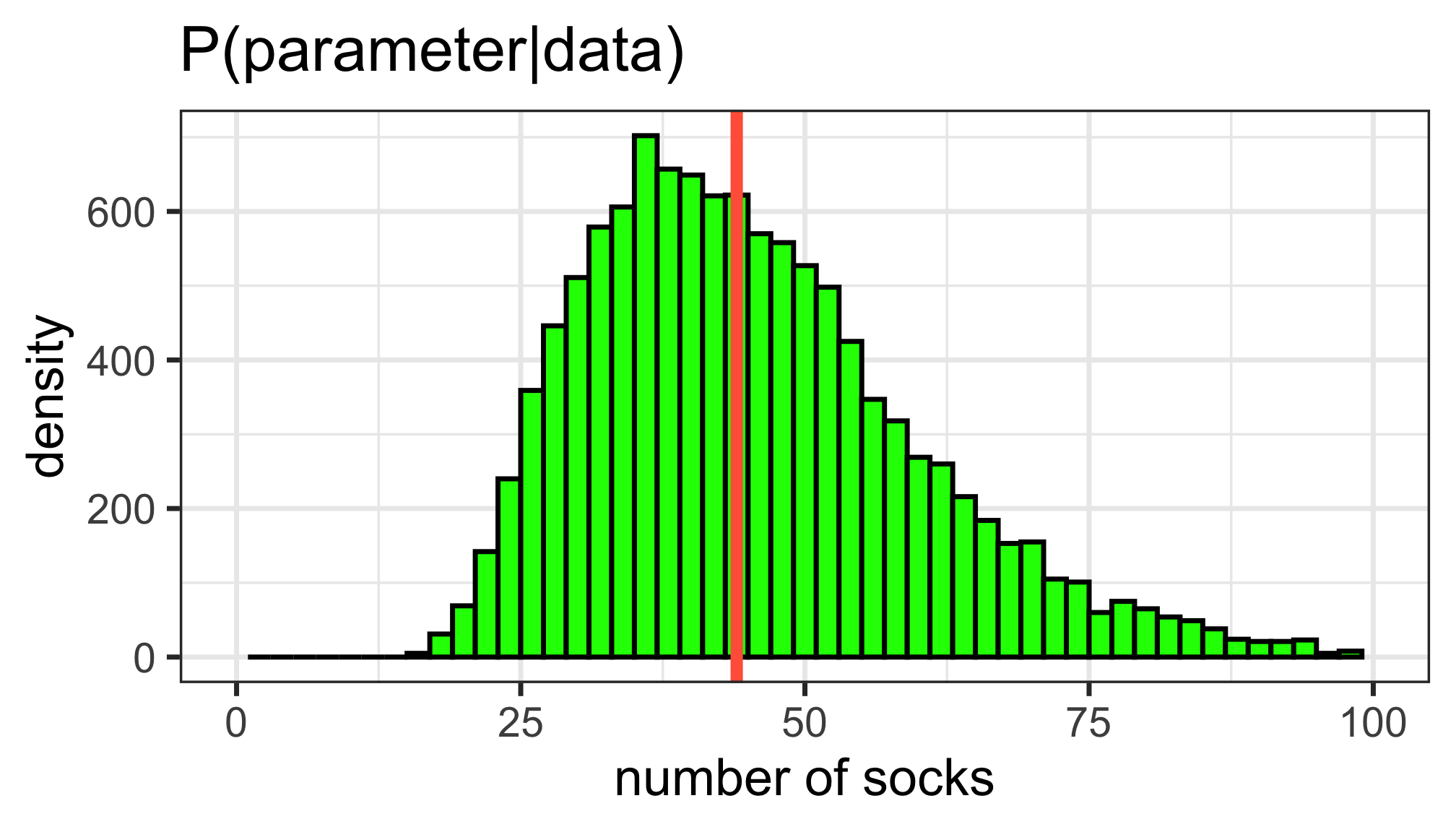
  • The posterior median is 44 socks.

Karl Broman’s socks
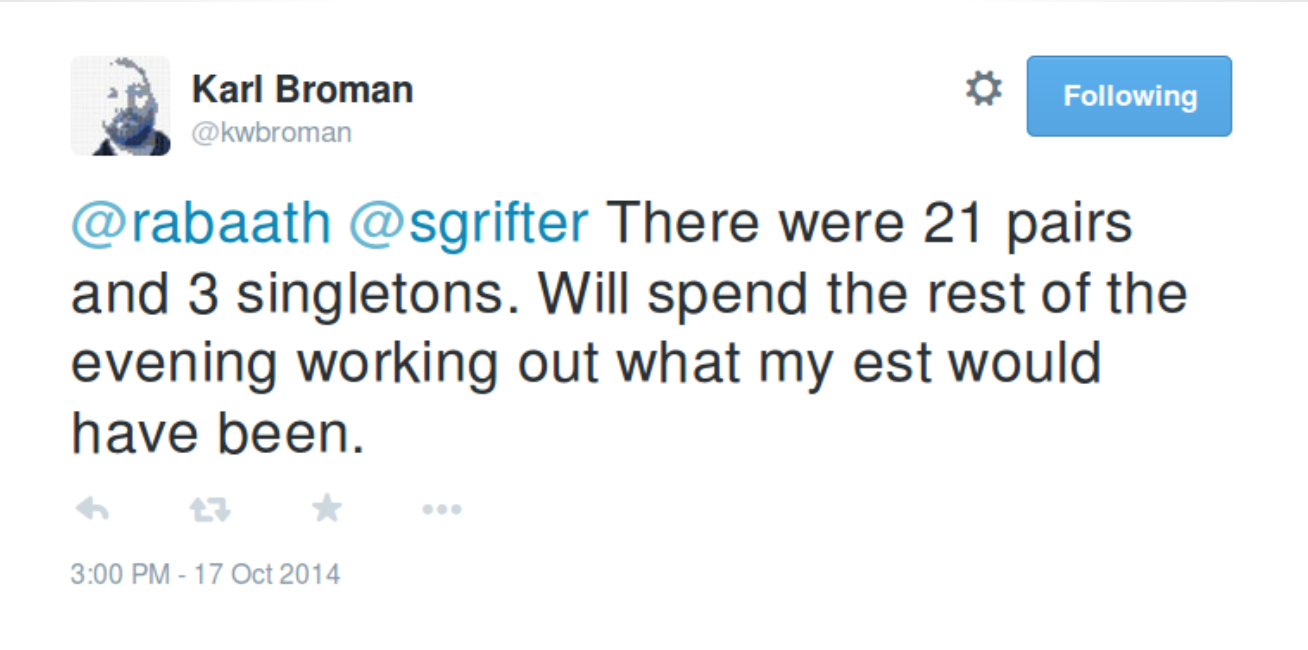
\[ 21 \times 2 + 3 = 45 \textrm{ socks} \]
Summary

Bayesian methods . . .

  • Require the subjective specification of your prior knowledge
  • Provide a posterior distribution on the parameters
  • Are usually computationally intensive
  • Have strong intuition

Thanks for a fantastic semester!